February 28, 2016

Winter's Eve Celebration - December 6, 2014

Ethan Allen Homestead Kitchen - A nice warm place on a winter's night.
Photo from a visit in May of 2010.
Getting back to recounting my first season as a reenactor with the recreated Seth Warner's Regiment.

The last event of the 2014 season was the Winter's Eve celebration at the Ethan Allen Homestead in Burlington, VT.

I'd visited the Homestead a few times in the past as a tourist.  The Winter's Eve celebration of 2014 was my first time being there as a participant instead of a viewer.  My six year-old daughter joined me, as she was sort of curious about "the olden days", and she wanted to hang out with dad for a bit.

The day actually consisted of two parts.  The first part was a work party, where members of the regiment took over one of the museum's meeting rooms to measure out gunpowder and make up cartridges for the next season.  Having never made up cartridges before, I was given a quick overview of the process, then added to the assembly line of folks who were already there when Gabriella and I arrived.

For blank cartridges (i.e. powder only, no ball), the process was pretty simple.  Pre-cut papers were rolled around a cylindrical former of the proper caliber, then folded as the end to create a cartridge.  These empty cartridges were then passed to the next group, who measured out an amount of gunpowder, filled a cartridge, twisted the end shut, and added to a pile of finished cartridges.  The finished cartridges were then counted out into individual sets which were bagged in preparation for being handed out to individual soldiers at upcoming events.  The process, once we got into the rhythm, was very quick, and even my daughter got into rolling empty cartridges with us.

For the second part of the event, we donned our 18th century clothing and joined the public for a relaxing evening of socialization.  My daughter decided that she'd like to participate as well.  The director of the museum, who was also a member of Warner's, found some costume clothing for her to wear.  Within just a few minutes, my modern 6 year-old with pink shirt and sparkly boots was transformed into a skirted and hair-capped youngster from the 1700s.

The night was a lot of fun.  The museum gave lantern-light tours of the house, where volunteers were playing Ethan and Fanny Allen.  The house itself was lit by candlelight, and warmth was provided by the kitchen and bedroom fireplaces.  My daughter listened intently as Ethan Allen recounted his history, and talked about his book-writing.  While she received a history lesson, Warner's gathered in the kitchen, sitting around the fire and visiting.  While it wasn't quite a time-travel moment for me, it was pretty close.  It was easy to see how folks living through the winters of New England would have gathered and kept themselves entertained with stories from their neighbors.  The candlelight inside and cold weather outside actually made for a pretty incredible atmosphere.

Back in the visitor's center of the museum, in the Homestead's recreated "tavern", drinks and snacks were being served.  Another group, also in 18th century attire, was demonstrating and teaching period dancing, which was similar to a combination of modern line and square dancing.  A few of us joined the group and the public for some dances.  Many of us quickly found that we can't count to two very well, or keep up with instructions in time to music.

For Gabriella, the most exciting part of the evening was meeting the "schoolmaster".  A gentleman was set up in one corner of the tavern with paper, ink and quills.  He showed visitors how to write with a quill, a process that my daughter found fascinating.  She spent most of the evening happily drawing lines and letters with a quill and ink, occasionally bouncing up to the tavern bar to grab another cookie.  When we returned home that night, she talked all the way home about meeting "the inkmaster, and Ethan Ellen, and dancing, and olden times clothes."  She was hooked.

The end of the event came with a small sketch performed by the members of Warner's.  A dispatch arrived "from the Continental Army".  One of the men brought the dispatch to the Captain, who read it aloud to the public, then explained that one of the other men was going to be promoted.  The second man arrived, and promoted to Ensign of the company.  The sketch actually provided for two things.  First, it was an entertaining way to educate the public.  Second, it served as the actual promotion of the men in question within the unit.

Thus ended my first season as a reenactor.  The rest of the winter was spent researching, reading, and talking about the time-period.  My daughter also couldn't stop talking about the event.  She wanted to know if she could go with me to the next one, and spent her winter asking, almost every day it seemed, when the next event would be.

July 24, 2015

The Battle of Red Horse Tavern - 2014

The Wayside Tavern - Photo from The Boston Globe
My next event after Bennington was on November 1st of 2014.  Each year the Sudbury Minutemen host a fictional battle at Longfellow's Wayside Tavern in Sudbury, MA.  Titled "The Battle of Red Horse Tavern", the one day event has rebels and those loyal to King George fighting for control of a tavern along the Boston Post Road.

The night before being Halloween, and therefore filled with family kid activities at home, I drove down the morning of the battle.  Unfortunately, I took a wrong turn at some point, and ended up arriving late.  In fact, I arrived just as the morning battle was starting.  As I made may way from the parking area, British regulars were pushing militia troops across a small foot bridge, away from the tavern, making it impossible to pass.  The main fighting would be taking place near a restored grist mill just up the road.  I stopped next to the path to the tavern and watched the battle.  A small bit of rain started to fall just as the first shots were fired.

After the action passed by where I stood watching, I made my way from the parking area to the tavern, hoping to find my regiment.  They, however, were already out in the field.  Since I needed to borrow gear to participate, I tucked myself back into my car to keep myself, and my firelock, dry until I could meet up with the others.  As I sat, I listened to the sound of the battle up the road.  Though I was in my car, it wasn't hard to imagine what it must have been like for people of the time to hide themselves away as combatants battled it out just outside of their homes.

After some time, the sound of musketry stopped and men started marching back in toward the tavern.  I made my way that way as well, and soon met up with the others from Warner's.  Most of them had come down the night before, spending the night at another 18th century tavern before coming to the Wayside for the event.  Our quartermaster was holding a sleeved waistcoat for me, which I gladly put on.  A late autumn rain isn't a lot of fun to stand in wearing just a linen shirt.

Between the morning battle and the afternoon battle, the tavern served lunch to the participants from both sides.  We lined up with our bowls, each of us taking a nice helping of warm stew.  We stood under a nearby tree while we ate, keeping some of the rain off.  With lunch finished, we took a look inside the tavern.  Stepping inside, we were introduced to men and women, most dressed in 18th century clothing, drinking, eating, talking and laughing.  I had one of "those moments" when I was briefly transported back in time.  It was a very cool feeling.

After a bit, some of us wandered back outside to check out the sutlers tents, and generally wait around for orders for the afternoon.  The rain seemed to ebb and flow, making us a bit damp, but no one seemed to be in low spirits because of it.  Unfortunately, after a meeting of the officers, it was decided that the afternoon battle would be called off.  The rain apparently was not only going to continue, but was forecast to become worse, with the addition of wind on top of it.

That night, after returning home, I wrote the following for my Facebook status:

"After Action Report of the Battle of Red Horse Tavern:

The flowery version:

1st Nov., along the Boston Post Road -
The day was somewhat lowering as I approached. Our orders were to rally at the tavern to join our units. His Majesty's troops had discovered the muster area. In the instance that I arrived, both Heaven and the Enemy opened up. Steady rain fell as They pushed our men across the bridge and away from the Tavern. Having neither ball nor powder, I secreted myself away, keeping my lock dry in hopes of finding my unit once the enemy passed. The fight continued, moving West past the village Church toward the grist mill. I listened to the musketry sounding hot for near an hour. Presently our troops returned triumphant and I was able to join the men. The tavern filled with joyous laughter. The rain fell. Much food and spirits were shared. The enemy was still near, but Nature forced both sides to hunker down, keeping powder and feet dry.


 The modern version:

I missed the first fight, the stew was good, then we got rained out."

July 16, 2015

Joining the Continental Army

Militia at Bennington (I'm in the blue to the right) - August 16, 2014
From the Flickr stream of Henry Rutkowski

As I mentioned in my last post (almost a year ago now), I joined the re-enacting unit of Col. Seth Warner's Recreated Extra-Continental Regiment.  In an effort to catch up on this blog, I'll write up the events that I've participated in during the past year.

My first event was the recreation of the Battle of Bennington in Walloomsac, New York.  This was a two day event that took place on the actual battlefield, 237 years to the day that it occurred.

At the time of the event, I lived just about a half-hour away, so I drove down first thing on Saturday morning to join the regiment.  I was a bit nervous, both because it was my first event, and because I'd only met a couple of the folks from Warner's briefly as a visitor at past events.  I'd been corresponding with them via email for a couple of months, but it's still nerve-wracking to join an established group of people as the new-comer.

Finding the site wasn't too difficult.  The Bennington Battlefield State Park is well marked.  The camp for the armies was opposite the park, down a short hilly road, in the back field of an old farmhouse next to the Walloomsac River.  If I remember correctly, we were camped on the actual grounds where the German troops had been encamped.  After signing in, finding a parking spot, and trying to put my clothes together as well as I could, I made my way over to Warner's dining fly and tents.  I re-introduced myself to the people that I recognized, and met a few others.  Almost instantly, loaner gear and clothing started being tossed in my direction, even from folks that I hadn't met yet.  I had sewn myself a shirt and a pair of breeches, and found myself a round hat, but other than those bits and my musket, I didn't have anything close to period equipment on me.

Once my modern socks had been replaced with stockings, and my modern shoes traded for a pair of loaner moccasins, I was handed a sleeved waistcoat, a canteen and a cartridge box.  I went from lost nervous modern visitor from 2014 to lost nervous militia augmentee from 1777.  Soon I was handed off to a couple of the seasoned re-enactors, who brought me up to speed on some of the basic movements, and how to handle my musket.  Once they were satisfied that I wouldn't hurt myself, or anyone else, I was folded into the larger group to learn how to maneuver with them.  The recreated battle took place in the afternoon, so we had all morning to train.

Areas of Action - Recreated Battle of Bennington, August 16 & 17, 2015
For the first battle, I was given a wooden "flint" to place in my musket.  While I would be marching and fighting with the regiment, I hadn't yet been safety certified, so I would not be carrying powder.  The wooden replacement would allow me to go through the motions of firing while in the field, without sparking my musket with each trigger pull.

The scripted scenario for the recreation, split into two actions, loosely followed the order of the actual battle.  For the first action, German troops were stationed in a redoubt on the high ground of the battlefield.  Native and Loyalist militia units also took to the field.  Continental units were tasked with taking the redoubt.  For the second action, the two sides were swapped, with the Continentals attacking back toward the direction they had just come from.  Warner's would be playing both militia and Continental regulars.

For the main battle, we had to march from camp, up the Battlefield Park's access road, a distance of about eight-tenths of a mile, with an elevation difference of roughly 300 feet.  Since we wouldn't be returning to the camp in between actions, those who would be playing both militia and line troops rolled their uniform pieces up in bedrolls to both carry them and keep them concealed during the first action.  As we began to march out, one of the men looked at me and said "We're playing militia, just pretend that you don't know what you're doing."  "Perfect," I said, "I don't know what I'm doing."

The march up the hill was taken slowly.  Participant ages ranged from teenagers to people 20 or 30 years older than me.  Due to this, leadership was careful to keep a slow pace, and to give rest and water breaks along the way.  I wasn't in the best shape (I'm still not), but I found the pace workable.  I was actually surprised at how comfortable I was, marching in summer heat while wearing heavy clothing and carrying a firelock.

As we neared the battlefield, the infantry column cut into the woods, heading toward the northern end of the battlefield were we would be starting the scenario.  Since I was wearing moccasins, and I'm used to going barefoot most of the summer, this was actually a welcome relief for my feet.  We halted at the top of the hill, waiting for units behind us, including the British column, to make their way up the road.  Starting to get into the mood, our unit went into a security stance, taking a knee while watching the woods for movement.  This was the moment when I had my first "time-travel".

I've read of other re-enactors having moments when their minds momentarily transport them back in time.  The modern world disappears for a moment, and you get a sense of the reality that the people of the time period you're portraying lived in.  For me, that moment was kneeling in the woods, surrounded by militia, staring into the trees for any glimpse of motion that might indicate enemy approaching.  As we knelt there, one of the officers whispered "Look for the white trim on their hats.  It's a dead giveaway in the woods."

In reality, the units portraying British troops were in column, maybe fifty yards behind us, climbing the same hill that we had climbed as they worked their way to their starting positions.  At some point we let our guard down, and the modern world came back.  Soon a steady line of red-clad men walked by us as the British moved past to find their places on the field.  It was sort of a comical moment as the two sides warily eyed each other, even though many on both sides have known each other for years as participants in the hobby.

Period map of the original battle.  North is to the right.
After standing around for some time, we finally moved again and took our position in the bushes just off the north end of the field.  We would be pushing our way south-east, across a couple of open spaces, then on to the redoubt.  After just a few minutes the action began.  Popping could be heard across the field in front of us, then suddenly we were moving.

My memories at this point are just flashes.  I recall seeing one of our officers giving commands.  I remember following the guy to my left.  I recall crashing into the woods, and hearing the bellowing of commands in German from across the field, and Indian war-cries off to one side.  There was lots of smoke, and yelling, and running.

It was awesome.

Later one of our officers who had been in the modern military told me that the tunnel vision I experienced is common for soldiers even today.  Your mind focuses so narrowly on your task, that all extra information is filtered out.  This, he said, is why you may read first-person accounts of battles that seem like the people were in two completely different places.  What the man to your left sees and remembers is completely different from what the man to your right sees and remembers.  It's an interesting fact to keep in mind while doing research.

At the end of our initial push, we found ourselves stopped in the woods across the road from the recreated redoubt.  A barbed-wire fence in the trees had slowed us, and the public crowd watching the action was to our front.  We held here for what seemed like several minutes, then heard the command to charge.  Continental militia poured from the trees, across the road, and up the slope to the redoubt.  The enemy fled, and the first action of the scenario was over.  Our unit gathered behind some trees, out of site of the public, and those who had brought regimental jackets began to transform into uniformed line troops.

For the second action of the scenario, the crowd was moved to the field that we had crossed before coming to a stop in the woods.  We lined up and faced north, back toward the direction we had just come from.  This phase of the scenario was to depict Seth Warner's troops reinforcing the Continental army, as had been done in 1777.  Our unit, being the recreated Warner's Regiment, would be portraying ourselves.  As such, the rest of the army was placed in the action first, with our troops coming onto the field at the end.

For us, once we were put into play, the second action was relatively quick.  There was a cannon across the field, which we were to capture.  We flanked to our right, took the cannon, then  moved to fire on the last of the enemy troops that were coming onto the field.  We moved quickly enough that I recall one of the cannon crew members, now behind me, saying "Uh, is anyone going to capture me?"

With the battle over, the public dispersed.  We were given orders to police up any cartridge papers that had been dropped on the field, then we formed up for a memorial ceremony at the battlefield's monument.  The ceremony was neat, with all of the troops standing at attention, circling the flag pole.  Across the way from us were the German troops.  Next to them were some British, some Loyalist, and so on around to the Continental side where we stood.  Some speeches were made by local community members, and I believe there was also a short prayer for the fallen.

After the ceremony, we were to make our way back to camp.  Before the march, I took stock of my situation.  The brass tip of my wooden rammer had broken off, and my breeches had split stem to stern, leaving me a bit breezy below the waistline.  I don't recall either of them happening, but it was kind of funny to think that some treasure-hunter a couple hundred years from now might find the tip of my rammer on the battlefield.

The march back to camp, being downhill, was easier and quicker than the march up.  I had originally intended on spending the night in camp, but given my wardrobe malfunction, and how close to home I was, I decided to drive home to repair my breeches.

Warner's Regiment, marching to battle
From the Flickr stream of Henry Rutkowski
The next morning I arrived just in time to share in breakfast.  After breakfast, I again did some individual training, then was safety tested so that I could use powder in my next fight.  There were two battles on Sunday, but our unit sat out the first, which was a small skirmish between the Continentals and Germans at the bridge next to the camps.  The battle actually ended in the camps, with the Germans being defeated.

The final engagement for the weekend was in a small field on the other side of the river from the camps.  For this one, I was issued powder and a borrowed musket (mine wasn't working correctly).  The march was about a half mile, and much less steep than the day before.  For this scenario, we would be facing off against Loyalist who were fortified behind a breastwork that had been thrown up for their protection.  For this battle, we would be fighting in close order, with just a few inches between each man.  There were enough people for us to form two companies, so we attacked with alternating volleys from each.  This fight, though short, moved much slower than the main battle.  We moved forward, fired, reloaded, moved, and fired.  Within just a few minutes of starting our attack, we were given the order to charge and the breastwork was overrun.

The Battle of Bennington, for me, was an awesome weekend.  Though I didn't know what I was doing much of the time, I felt welcomed and encouraged.  I got to take part in everything even though I was the new guy, and I always felt open to ask even the simplest of questions.  I drove home with a smile on my face, eager to start collecting my own gear so that I could take part in the next event.

August 21, 2014

Catching Up - Eli's Shirt

A lot has happened since my last entry nine months ago.  I've hand-constructed a shirt, purchased a musket, joined a reenacting unit, machine sewn a pair of breeches, and continued to research.

The unit that I've joined is Warner's Regiment, based in and around Vermont.  This choice may change my impression some, as Warner's is a military unit far removed from Eli's Boston.  I attended my first reenactment with them this past weekend though, and I believe I've made a good choice.  The purpose of this post, however, is to update my documentation regarding my persona's clothing.

As mentioned in the post Clothing Eli, and period documented in the post Shirt - A Basic Definition, my first piece of clothing for Eli was a basic shirt.  Using advice from folks on a couple of online forums, I was able to hand-sew the entire garment.  It's not 100% accurate, as I used synthetic thread, but it came out well for my first attempt.  The shirt is comfortable, and fits fairly well.  The only issue that I've had is that the thread buttons I made for it don't hold that well.

First, a couple of overview shots of the front and back. 

Front
Rear


The shirt is made up of basic shapes, including rectangles for the collar and shoulder reinforcing and triangular gussets to provide room in the neck.

Shoulder Reinforcing
Neck Gusset


Additional gussets provide room in the underarms and at the sides.

Arm Gusset
Side Gusset


The neckline is rolled and stitched to finish the edge.  Thread buttons are attached to close the neck and cuffs.  I may remove the cuff buttons and replace them with buttonholes for cuff-links at some point, which would be more correct for the time-period.

Neckline Detail
Thread Button Detail


The shirt was a great first project.  The pattern of rectangles and triangles is easy to cut, and, since this is a base garment, mistakes are pretty well hidden under other clothing.

December 10, 2013

Getting into Eli’s World

Boston - 1775
The other night I bought a copy of Stacy Roth’s “Past into Present: Effective Techniques for First-Person Historical Interpretation”.  One of the interesting topics that she mentions is “Worldview”.  Worldview is basically how a character sees the world around them.  What’s going on in their time and place?  What memories do they have?  What are their hopes and motivations?  Basically, back-story and setting for the character, so that they can answer questions or speak in a natural way, without the answer or presentation seeming like a rehearsed lecture.
The reenactors at Plimoth Plantation in Massachusetts do a great job at this.  A few years ago I visited there with some friends and the curator of the Pilgrim Hall Museum.  The curator knew many of the folks working in the Plantation village.  They greeted him as an old friend, but never broke character, asking if he’d been traveling, as they hadn’t seen him for some time.  After being introduced, one of the reenactors asked where I was from.  “Far north of here,” I answered, “Vermont.”  “Ah,” the character nodded, “Is that near the French?”  We then fell into an easy conversation about her garden, clothes and house.  At one point she casually mentioned the last supply ship that had come to the colony.  Later, while talking to another reenactor, he too mentioned the supply ship, but more in depth and from a different perspective.  All of the characters were on the same timeline.  They knew what was going on in their time and place, they had memories of past events, and they each reacted to them based on their beliefs.  They each had their own worldview.
I began thinking about the worldview of Eli Davis.  I’ve chosen a time, occupation, and birth date for him, but what about his beliefs and history?  What was going on around him in Boston during 1776?  What would his reaction to events be?  The best way to discover this was to research primary documents.  Larger events of 1776 can be found in history books, but for day-to-day, nothing beats a newspaper.
The Massachusetts Historical Society has a great online collection of period newspapers.  Yesterday I sat down and read The Continental Journal and Weekly Advertiser for December 5, 1776 to see what sort of news Eli would be reading at this time of year.
A quick summary:
  • First up, “An Act for providing Reinforcement to the American Army”.  Towns are being ordered to set up militias to be used in case the American Army needs men due to termination of enlistments that are expected at the end of the year.
  • Next, “An Act to prevent forging and altering Bills of public Credit”.  The new government is issuing currency, and it will be illegal to forge such currency.  There will also be a fine for offering goods at cheaper prices to folks who pay in gold and silver instead of the new currency.
  • A report from a local merchant ship that French and Spanish ports are open to American ships, and that those ships are allowed to fly the American flag.
  • In Philadelphia, alliance treaties are being set up with local Indian tribes.
  • Overseas, France has turned down a request by Britain to march troops through their country.  There is “very great confusions” in Ireland, and British troops are expected to be sent there.  Spain has ceded land in the Caribbean to France, and both French and Spanish fleets, with troops, are expected to land in Jamaica.
  • Closer to home, reports of losses at Fort Washington in New York after a battle there, with 1,700 killed and 96 wagons loaded with wounded.
  • The War-Office is ready to receive fire-arms and cannon, and to enter into agreements with manufacturers of such items.
In short, Eli is living in a world at war.  The American army is being defeated, and may be disbanding due to enlistments running out.  Possible allies are at war with each other, and the economy is being changed by the currency of a new government.  There are some gains with the Indians, but overall the world seems pretty unstable.
On the plus side, commerce in Boston seems to be doing well.  There are several advertisements for goods for sale, houses for rent, and trades being plied; goods range anywhere from mundane items such as cloth, to entire ships being auctioned off at the wharfs.  Though busy, the paper gives Boston a small-town feel, not unlike the tourist town that I live in during modern times.  Strangers are coming and going, but streets and shops are well known.
In addition to the paper, a map of Boston from 1775 helps further define Eli’s worldview.  Overlaying the map on a modern-day map begins to give a sense of scale, and road names that are unfamiliar start to take shape.  The advertisements stating things like “midway down King Street” make more sense.
Knowing more about the details of the area of residence that I’ve chosen for Eli makes it easier to shape him.  I’ve decided to continue this sort of research by reading the newspapers of the times, at roughly the same time of year as they came out originally.  I eagerly await this coming Thursday’s Continental Journal!

November 30, 2013

Shirt - A Basic Definition


I thought it might be fun to document a shirt using a dictionary from the time-period. This morning I pulled up the Google Books copy of A New General English Dictionary[1] from 1771.

First, the basics:
Shirt
SHIRT (S.) a garment commonly worn by men next
[to] their skin, and generally made of linen.
Seems straight-forward enough. Just to dig a bit, I also looked up "garment" and "linen".

GA'RMENT (S.) any sort of cloathing or covering of
the body.
LI'NEN (S.) sometimes means cloth in whole pieces made
of flax or hemp, and sometimes shirts, shifts, sheets, table-
cloths, etc. made of such cloth.
And finally cloth:
CLOTH (S.) the matter or substance whereof garments are
made, which is sometimes composed of woollen, line, silk, etc.
Fair enough. In 1771, a shirt was a covering of the body, worn by men next to their skin, made of flax or hemp matter. So far so good. The shirt that I'm making was cut from linen cloth, will cover my body, and be worn next to my skin.


So what about the parts of the shirt?  The pattern I'm following has sleeves, gussets, a body, buttons, etc.

[SLEE]VE (S.) that part of a garment that [cont]ains the arm.

GU'SSET (S.) a piece of cloth much broader at one end than
the other, that is sown into other pieces to widen it, as women
do their shifts, seaman their sails, etc. ...

CO'LLAR (S.) ... also the narrow cape of a coat, the upper
part or band of a shirt, made fit to go about a person's neck;...
WRI'ST-BAND (S.) the broad fillet at the bottom of a shirt
sleeve, etc. wherein all the plaits are sewn or inserted, etc.
and which buttons round the wrist, etc.
Button didn't appear on its own as an entry, however I did find a description of what we would call cuff-links:

STUD (S.) ... sometimes 1 small button with two flat heads and
a neck between, used to button the wristbands or collars, etc.
of mens shirts; ...


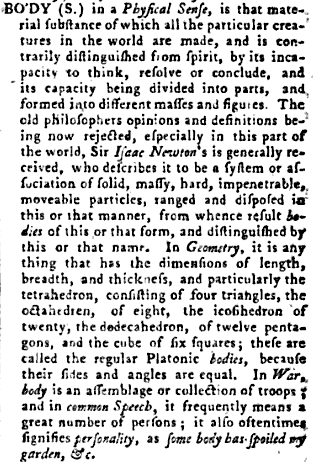
The closest description of the torso of a shirt was found under "Body", which also contains an awesome definition of the physical body of a person:

BO'DY (S.) ... In Geometry, it is any thing
that has the dimensions of length, breadth,
and thickness, and particularly the tetrahedron,
consisting of four triangles...
With all the pieces and parts documented, I looked at the process:

SEW (V.) to stitch or join cloth, etc. together with a needle,
an awl, etc. ...
STITCH (S.) a single operation of the needle, awl, etc. ...
STITCH (V.) to sew or fasten things together with a needle
awl, etc.
THREAD (S.) small twine of flax, wool, or silk, spun or twisted
together, for the use of sewing things together.
THREA'D or THRE'DDLE (V.) to put thread, silk, worsted, etc.
into a needle.
Last, I took a look at the definitions of the tools needed:

NEE'DLE (S.) a small instrument used in sewing; and according
to the application, it is different denominated; as, a stitchig-needle,
a flocking-needle, a packing-needle, etc. ...
SCI'SSORS or SI'ZZARS (S.) an instrument used for
many purposes, but especially to cut cloth, etc. made
of steel or hardened iron consisting of two sides or
cheeks made very sharp, and fastened with a rivet to
move upon.


 While I'm using the modern versions of these tools, they haven't changed much over the years, with the exception of how they were produced.  At a later date, I may make a more detail post about needles, in particular.

[1] Dyche, Thomas, and William Pardon, ed. A New General English Dictionary Peculiarly Calculated for the Use and Improvement of Such as are Unaquainted With the Learned Languages. London: 1771. http://books.google.com (accessed November 30, 2013).

Clothing Eli

Wow.  It’s been over a year.  Life got ahead of me, and this project was put on hold while my wife and I added a third daughter to our family.  Now that daughter is toddling around on her own two feet, I’m starting to find time to work on hobbies again.

Another project that I’ve been working on is an Italian Bauta costume.  I need a shirt for that outfit.  Conveniently, I can use the same style shirt for Eli Davis, Bookbinder.  I started to construct the shirt the other night using a sewing machine.  Yesterday I re-read this blog and was reminded of my goal to attempt using period techniques whenever possible.  Fortunately I had only sewn one seam by machine.  I’ve decided to make the rest of the shirt by hand.
In addition to using period techniques, another of my goals is to document this persona and his possessions as fully as possible, targeting the year 1776 in New England.
Documenting a shirt from the time period has been fairly easy, thanks to the previous works of numerous scholars and reenactors.  The instructions I’m following are from the website La Couturière Parisienne which shows a typical men’s shirt from the era.  The two books referenced by that page, L'art du tailleur (The Art of The Tailor) and  L'art de la linger (The Art of The Laundress) can both be found on the French National Library’sGallica website.
Another great page describing and documenting men’s shirts is this post from Two Nerdy History Girls.  They show detail that I was not able to see in places such as the links from the 18thCentury Men’s Shirts page at the 18th Century Notebook site.  Searching Pinterest for “18th century shirt” also turned up numerous photos from museum collections, all documented to the time period.
Finally, reaching out to the 18th Century Life Yahoo group led to some great tips on sewing, another pattern, some instructions on sewing buttons like those pictured on the Two Nerdy History Girls site, and a video on how to construct button holes.
One interesting thing that I did find, or rather didn’t find, while researching shirts was that, in the estate inventory of a bookbinder who died in 1799, no clothing was listed.  The inventory was taken a year or so after his death.  I wonder if the clothing had been given to others, or perhaps even sent to be made into paper for books?
In addition to researching, I’ve been slowing working on the shirt.  I’m finding that I actually enjoy hand-sewing, even if my stitching isn’t straight.  I like that I can sit on the couch in front of the TV or computer, while the kids run crazily around the room, and still make some progress.  There’s no need to drag out a machine, set it up, shoo the kids away from it, and so on.  All I need to do to work is to pick up the fabric, needle and thread.  Easy as easy can be.
I'll follow up with photos when the shirt reaches completion.

August 9, 2012

In Miniature

Final Entry - Photo 3 

I still haven't done much with my persona building.  I have, however, been building.  The majority of my hobbies involve creating of some sort.  Recently, for a war-gaming terrain building challenge over on TerraGenesis, I decided to create a small example of a RevWar camp.  So, while I'm not advancing my persona much, I am staying in the time-period.

July 9, 2012

Hubbardton 2012


Though I haven't done much research or work on my bookbinder persona, I have been doing some reading on the time-period.  I've also been trying to keep up on local reenactments.  This past weekend my family visited Hubbardton Battlefield for the annual reenactment there.  This year marks 235 years since the actual battle.

Hubbardton is actually one of my favorite spots to visit, especially during the off-season when no one is around.  The surrounding mountains are beautiful, and the terrain is basically the same as it was the day of the battle.  Hiking up the hill from the British side, it is easy to see what they were faced with.

According to one of the volunteers at the site, this year's reenactor turnout for the event was pretty good, at over 300 people.  I'm not sure if that count included just troops, or all reenactors.  It was nice to see a German unit there, though six men representing von Riedesel's reinforcements was a little odd.  Still, everyone seemed to be having a good time, and the crowd seemed to really enjoy talking to the folks that made themselves available.

I wasn't able to stay long, but I did capture some photos of the event.

June 14, 2012

Folding Stick


One of the simplest pieces of a bookbinder's kit is a folding stick.[1] Used to fold signatures and press paper, a folding stick is basically just a rounded stick made out of any hard material.  I've seen modern folding sticks made of bone, wood, and plastic.  Some are shaped like pencils, others are more rounded.  To stay within my theme of an 18th-century bookbinder, I did a little research on what was used at the time.

It looks like ivory was the preferred material for folding sticks:

"The leaves are first folded with a thin piece of ivory called a folding-stick, and laid over each other in the order of the signatures..."[2]

"For any number of folds, however, a bone or ivory folder—a thin, smooth blade—was essential for rapid and accurate work."[3]

For the correct shape of a period bone folder, the website of Jeff Peachy offers some measurements taken from period sources for French folding sticks.  Basically the sticks were roughly 5 to 7 inches long, and sort of oval-shaped, tapering at the ends.

Using a sort of reverse description, this fits with other documentation that I found:

"Sepia, or the Scuttle-Fish, is found upon our Sea-Coasts plentiful enough: It is almost of the Form of a Spider, and so large, that the Bone taken out of its Body will sometimes measure six or seven Inches in Length.
    This Bone which is the Part we use is flat, white and thin, much in the Shape of what the Stationers call a Folding-Stick." [4]

Looking up the shape of a cuttle fish bone does indeed show a long bone, roughly half a foot long, with rounded ends.

To make my own bone folding stick, I started with a dog bone purchased from the pet store.  Using a hacksaw, I sawed off the flattest portion of the bone, then used the saw and some heavy-grit sandpaper to shape the piece into a rough rectangle.  I then used sandpaper to flatten the top and bottom so that I could draw the shape of the folding stick.  Again using the hacksaw, I rough cut a blank, then finished shaping with sandpaper, using finer and finer grits to get a nice smooth folder.  My folder isn't quite as nice as a professionally-built one, but it feels nice in my hand, and should work for it's intended purpose.

One suggestion for anyone who may also attempt to built something out of bone: wear a mask.  The bone dust is incredibly fine, and can get into your lungs easily.

[1] The Bookbinder in Eighteenth-century Williamsburg: An Account of His Life & Times, & of His Craft, (Williamsburg, VA: Colonial Williamsburg, 1959), 28.

[2] Temple H. Croker, Thomas Williams, and Samual Clarke, The complete dictionary of arts and sciences, Volume 1, (London: 1766)http://books.google.com/ (accessed June 11, 2012).

[3] The Bookbinder in Eighteenth-century Williamsburg, 29.

[4] R. Bradley, A Course of Lectures Upon The Materia Medica, Antient and Modern, (London: 1730)http://books.google.com/ (accessed June 8, 2012), 145.