Showing posts with label Research. Show all posts

December 10, 2013

Getting into Eli’s World

Boston - 1775
The other night I bought a copy of Stacy Roth’s “Past into Present: Effective Techniques for First-Person Historical Interpretation”.  One of the interesting topics that she mentions is “Worldview”.  Worldview is basically how a character sees the world around them.  What’s going on in their time and place?  What memories do they have?  What are their hopes and motivations?  Basically, back-story and setting for the character, so that they can answer questions or speak in a natural way, without the answer or presentation seeming like a rehearsed lecture.
The reenactors at Plimoth Plantation in Massachusetts do a great job at this.  A few years ago I visited there with some friends and the curator of the Pilgrim Hall Museum.  The curator knew many of the folks working in the Plantation village.  They greeted him as an old friend, but never broke character, asking if he’d been traveling, as they hadn’t seen him for some time.  After being introduced, one of the reenactors asked where I was from.  “Far north of here,” I answered, “Vermont.”  “Ah,” the character nodded, “Is that near the French?”  We then fell into an easy conversation about her garden, clothes and house.  At one point she casually mentioned the last supply ship that had come to the colony.  Later, while talking to another reenactor, he too mentioned the supply ship, but more in depth and from a different perspective.  All of the characters were on the same timeline.  They knew what was going on in their time and place, they had memories of past events, and they each reacted to them based on their beliefs.  They each had their own worldview.
I began thinking about the worldview of Eli Davis.  I’ve chosen a time, occupation, and birth date for him, but what about his beliefs and history?  What was going on around him in Boston during 1776?  What would his reaction to events be?  The best way to discover this was to research primary documents.  Larger events of 1776 can be found in history books, but for day-to-day, nothing beats a newspaper.
The Massachusetts Historical Society has a great online collection of period newspapers.  Yesterday I sat down and read The Continental Journal and Weekly Advertiser for December 5, 1776 to see what sort of news Eli would be reading at this time of year.
A quick summary:
  • First up, “An Act for providing Reinforcement to the American Army”.  Towns are being ordered to set up militias to be used in case the American Army needs men due to termination of enlistments that are expected at the end of the year.
  • Next, “An Act to prevent forging and altering Bills of public Credit”.  The new government is issuing currency, and it will be illegal to forge such currency.  There will also be a fine for offering goods at cheaper prices to folks who pay in gold and silver instead of the new currency.
  • A report from a local merchant ship that French and Spanish ports are open to American ships, and that those ships are allowed to fly the American flag.
  • In Philadelphia, alliance treaties are being set up with local Indian tribes.
  • Overseas, France has turned down a request by Britain to march troops through their country.  There is “very great confusions” in Ireland, and British troops are expected to be sent there.  Spain has ceded land in the Caribbean to France, and both French and Spanish fleets, with troops, are expected to land in Jamaica.
  • Closer to home, reports of losses at Fort Washington in New York after a battle there, with 1,700 killed and 96 wagons loaded with wounded.
  • The War-Office is ready to receive fire-arms and cannon, and to enter into agreements with manufacturers of such items.
In short, Eli is living in a world at war.  The American army is being defeated, and may be disbanding due to enlistments running out.  Possible allies are at war with each other, and the economy is being changed by the currency of a new government.  There are some gains with the Indians, but overall the world seems pretty unstable.
On the plus side, commerce in Boston seems to be doing well.  There are several advertisements for goods for sale, houses for rent, and trades being plied; goods range anywhere from mundane items such as cloth, to entire ships being auctioned off at the wharfs.  Though busy, the paper gives Boston a small-town feel, not unlike the tourist town that I live in during modern times.  Strangers are coming and going, but streets and shops are well known.
In addition to the paper, a map of Boston from 1775 helps further define Eli’s worldview.  Overlaying the map on a modern-day map begins to give a sense of scale, and road names that are unfamiliar start to take shape.  The advertisements stating things like “midway down King Street” make more sense.
Knowing more about the details of the area of residence that I’ve chosen for Eli makes it easier to shape him.  I’ve decided to continue this sort of research by reading the newspapers of the times, at roughly the same time of year as they came out originally.  I eagerly await this coming Thursday’s Continental Journal!

November 30, 2013

Shirt - A Basic Definition


I thought it might be fun to document a shirt using a dictionary from the time-period. This morning I pulled up the Google Books copy of A New General English Dictionary[1] from 1771.

First, the basics:
Shirt
SHIRT (S.) a garment commonly worn by men next
[to] their skin, and generally made of linen.
Seems straight-forward enough. Just to dig a bit, I also looked up "garment" and "linen".

GA'RMENT (S.) any sort of cloathing or covering of
the body.
LI'NEN (S.) sometimes means cloth in whole pieces made
of flax or hemp, and sometimes shirts, shifts, sheets, table-
cloths, etc. made of such cloth.
And finally cloth:
CLOTH (S.) the matter or substance whereof garments are
made, which is sometimes composed of woollen, line, silk, etc.
Fair enough. In 1771, a shirt was a covering of the body, worn by men next to their skin, made of flax or hemp matter. So far so good. The shirt that I'm making was cut from linen cloth, will cover my body, and be worn next to my skin.


So what about the parts of the shirt?  The pattern I'm following has sleeves, gussets, a body, buttons, etc.

[SLEE]VE (S.) that part of a garment that [cont]ains the arm.

GU'SSET (S.) a piece of cloth much broader at one end than
the other, that is sown into other pieces to widen it, as women
do their shifts, seaman their sails, etc. ...

CO'LLAR (S.) ... also the narrow cape of a coat, the upper
part or band of a shirt, made fit to go about a person's neck;...
WRI'ST-BAND (S.) the broad fillet at the bottom of a shirt
sleeve, etc. wherein all the plaits are sewn or inserted, etc.
and which buttons round the wrist, etc.
Button didn't appear on its own as an entry, however I did find a description of what we would call cuff-links:

STUD (S.) ... sometimes 1 small button with two flat heads and
a neck between, used to button the wristbands or collars, etc.
of mens shirts; ...


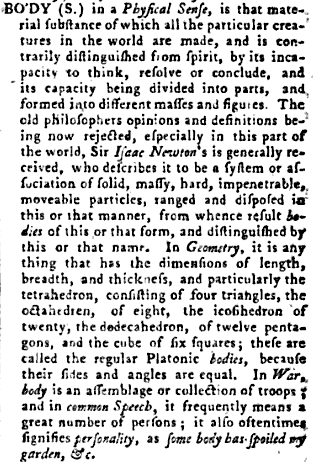
The closest description of the torso of a shirt was found under "Body", which also contains an awesome definition of the physical body of a person:

BO'DY (S.) ... In Geometry, it is any thing
that has the dimensions of length, breadth,
and thickness, and particularly the tetrahedron,
consisting of four triangles...
With all the pieces and parts documented, I looked at the process:

SEW (V.) to stitch or join cloth, etc. together with a needle,
an awl, etc. ...
STITCH (S.) a single operation of the needle, awl, etc. ...
STITCH (V.) to sew or fasten things together with a needle
awl, etc.
THREAD (S.) small twine of flax, wool, or silk, spun or twisted
together, for the use of sewing things together.
THREA'D or THRE'DDLE (V.) to put thread, silk, worsted, etc.
into a needle.
Last, I took a look at the definitions of the tools needed:

NEE'DLE (S.) a small instrument used in sewing; and according
to the application, it is different denominated; as, a stitchig-needle,
a flocking-needle, a packing-needle, etc. ...
SCI'SSORS or SI'ZZARS (S.) an instrument used for
many purposes, but especially to cut cloth, etc. made
of steel or hardened iron consisting of two sides or
cheeks made very sharp, and fastened with a rivet to
move upon.


 While I'm using the modern versions of these tools, they haven't changed much over the years, with the exception of how they were produced.  At a later date, I may make a more detail post about needles, in particular.

[1] Dyche, Thomas, and William Pardon, ed. A New General English Dictionary Peculiarly Calculated for the Use and Improvement of Such as are Unaquainted With the Learned Languages. London: 1771. http://books.google.com (accessed November 30, 2013).

Clothing Eli

Wow.  It’s been over a year.  Life got ahead of me, and this project was put on hold while my wife and I added a third daughter to our family.  Now that daughter is toddling around on her own two feet, I’m starting to find time to work on hobbies again.

Another project that I’ve been working on is an Italian Bauta costume.  I need a shirt for that outfit.  Conveniently, I can use the same style shirt for Eli Davis, Bookbinder.  I started to construct the shirt the other night using a sewing machine.  Yesterday I re-read this blog and was reminded of my goal to attempt using period techniques whenever possible.  Fortunately I had only sewn one seam by machine.  I’ve decided to make the rest of the shirt by hand.
In addition to using period techniques, another of my goals is to document this persona and his possessions as fully as possible, targeting the year 1776 in New England.
Documenting a shirt from the time period has been fairly easy, thanks to the previous works of numerous scholars and reenactors.  The instructions I’m following are from the website La Couturière Parisienne which shows a typical men’s shirt from the era.  The two books referenced by that page, L'art du tailleur (The Art of The Tailor) and  L'art de la linger (The Art of The Laundress) can both be found on the French National Library’sGallica website.
Another great page describing and documenting men’s shirts is this post from Two Nerdy History Girls.  They show detail that I was not able to see in places such as the links from the 18thCentury Men’s Shirts page at the 18th Century Notebook site.  Searching Pinterest for “18th century shirt” also turned up numerous photos from museum collections, all documented to the time period.
Finally, reaching out to the 18th Century Life Yahoo group led to some great tips on sewing, another pattern, some instructions on sewing buttons like those pictured on the Two Nerdy History Girls site, and a video on how to construct button holes.
One interesting thing that I did find, or rather didn’t find, while researching shirts was that, in the estate inventory of a bookbinder who died in 1799, no clothing was listed.  The inventory was taken a year or so after his death.  I wonder if the clothing had been given to others, or perhaps even sent to be made into paper for books?
In addition to researching, I’ve been slowing working on the shirt.  I’m finding that I actually enjoy hand-sewing, even if my stitching isn’t straight.  I like that I can sit on the couch in front of the TV or computer, while the kids run crazily around the room, and still make some progress.  There’s no need to drag out a machine, set it up, shoo the kids away from it, and so on.  All I need to do to work is to pick up the fabric, needle and thread.  Easy as easy can be.
I'll follow up with photos when the shirt reaches completion.

June 10, 2012

"Words, words, words."

Over the past week or more, I've sort of overloaded myself on words.  In addition to reading Arithmetic made familiar and easy, I've also been locating and reading what I can about the craft of bookbinding, and trying to relate it back to 1776.  Fortunately the art hasn't changed much, so even modern books are useful in learning how to bind books.  I've done a few simple bindings in the past, but I'd really like to document the trade for my target time period.

For reading material, I've dug up two books that I had purchased several years ago.  The Craft of Bookbinding by Manly Banister, though written in modern times, is a good overview of how to make your own binding equipment, and the process of either repairing or binding books.  The second book, Hand Bookbinding: A Manual of Instruction by Aldren A. Watson, published in 1996, is also a modern book, but it illustrates a more traditional look at the tools of the trade.  I actually used the Watson book to begin building my own tools a few years ago.  Sadly, those tools are now lost.  Happily, that means I get to build them again.

Supplementing the above books, I also downloaded from Google Books The Art of Bookbinding: Containing A Description of The Tools, Forwarding, Gilding and Finishing, Stationary Binding, Edge-Colouring, Marbling, Sprinkling, &tc., &tc. by A. Parry, published in London in 1818.  While out of my time-period, it's far closer to my target than the first two books.  I've only had a chance to skim the contents, but it seems very comprehensive.

To help me document the Colonial period more, I purchased two other books.  The first, The Bookbinder in Eighteenth-century Williamsburg: An Account of His Life & Times, & of His Craft, published by Colonial Williamsburg in 1959, is a good overview of a period bookbinder, though the booklet itself runs only 36 pages.  The second book is more detailed.  Bookbinding in Colonial Virginia, also published by Colonial Williamsburg, details an in-depth study of several binders, their businesses, tools, and examples of their work.  The most exciting portion of the book for me, so far, is a transcription of an estate inventory, listing tools, equipment, and supplies of a late eighteenth-century bookbinder.  This will be incredibly useful in recreating a bookbinder of that time.

In between reading, and searching, and the usual tasks of working and raising children, I've also started building my bookbinding tools, starting with a simple folding stick.  I'll document that process in a later post.

May 26, 2012

Education

As I've been researching and fleshing out my persona, I've been wondering about his education.  Being a bookbinder, and possibly a printer or bookseller as well, I'm assuming that he would, at the very least, be literate.  In addition to reading, I would guess that he also has basic writing and math skills.

Yesterday I spent some time looking into writing in the time period.  It would appear that a style of what is now considered calligraphy, Copperplate Round, or Round Hand, was a popular handwriting of the time.  I did some general internet searches and reading, but nothing really exciting enough to write about.

While I was reading, I did, however, come across something interesting on a blog called Slightly Obsessed.  In particular, the post Run like the Devil from the Excise Man got my attention.  First, the main image is of a nicely bound journal.  More importantly, though, is the mention of taxes and accounting for businesses.  These are two topics that I immediately added to my research list, as they would definitely affect my bookbinder.  This is also the point where I decided that Eli Davis was definitely an educated man.  He would, at the very least, have to be educated enough to run his own business.

Sufficiently sidetracked in my research now, I began looking for accounting books of the time.  My good friend Google Books turned up a few things, including Book-keeping Methodised by John Mair, printed in 1772, and An Essay on Book-Keeping by William Webster, which was mentioned in the Slightly Obsessed post.

While I was looking through these books, I began to wonder about how Eli might have learned arithmetic.  I remembered hearing the term "Learning his cyphers" one time in regards to learning math.  I typed "Cyphers" into the Google Books search box, filtered by dates between 1735 and 1776, and found Arithmetic Made Familiar and easy to Young Gentlemen and Ladies, printed during 1748 in London.

The preface of the book begins by stating that fractions will not be covered in the text as "most common Business may be carried on with the Knowledge of Whole Numbers only..."[1]

"Okay, good," I thought with a chuckle, "Everything I need to know about business, I can learn from this book."

I read more of the preface.  After a long history of the origin of arithmetic, the author writes something interesting about how various cultures do calculations.  Some calculated on their fingers, without using a pen and paper. Some used grain.  The Chinese, he states "do not much regard Rules in their Calculations, instead of which (Father le Comte tells us) they use an Instrument made of a Plate a Foot and a half long, across which are fitted ten or twelve Iron Wires, whereon are strung little round Balls: By drawing these together, and dispersing them again one after another, they calculate with great Ease and Expedition."[2]

The author had just described an abacus.  Since they were known in 1748, I wondered if they may have been used by New England business owners in 1776.  Something else to add to the research list.

After finishing the preface, I continued reading, covering a few chapters of the book, including notation, addition, and subtraction.  I think I'll cover that reading in another post.

One final thought from the author that I thought was interesting. In the introduction, the author explains how learning arithmetic is useful to those who would go into business, or to those who would like to improve their station in life.  He ends by stating: "Even the Ladies themselves, who have generally the Care of the domestic Expense of a Family ought therefore to have a proper Share of this useful Accomplishment."[3]

That one statement gives an interesting glimpse into the social world of the 18th century.

[1] Arithmetic Made familiar and easy to Young Gentlemen and Ladies, Being the Second Volume of the Circle of the Sciences, &c., (London: John Newbery, 1748) http://books.google.com/ (accessed May 25, 2012), A2.

[2] Ibid. A6.

[3] Ibid. 2.

May 25, 2012

Bookbinder Ads & Banishment

My copy of the Spring 2012 issue of American Ancestors magazine arrived in the mail yesterday.  In it, there was a mention that members of the NEHGS have online access to the Readex collection 19th Century U.S. Newspapers, Early American Newspapers, Series I 1690-1876.

Armed with this information, I headed to my computer last evening and began playing.  Keying the term "bookbinder" into the search box after logging in via my NEHGS account, and limiting the search to the year 1776, turned up 22 individual articles.  As I began looking through them, I saw that they were all ads for bookbinders, mostly in New York.  The others were from Connecticut, Rhode Island, and Boston.  Some of the advertisements were duplicates, printed in more than one issue of a particular newspaper.  The ads are interesting on their own, easily establishing the trade in New England, and giving a bit of insight into the occupation.  It appears that many of the bookbinders also sold the books, along with other items such as stationary.  A couple mention printing as well.  It looks like my persona could open up his options, and if I ever decided to pursue it, I might have a good basis for a small business if I ever attend reenactment events as a participant.

The ad below, from the Connecticut Courant, shows that the advertiser was not only a bookbinder, but also a stationer and bookseller.  It also gives a flavor of the political atmosphere of the time.  The Hartford printing office is also mentioned, which, the way I read it, was probably a separate business.

The next three ads come from The Constitutional Gazette, printed in New York.  The first and third again show that bookbinders also sold books and stationary, and that the topics of items being printed were related to the current events of the time.  The second item below is a help-wanted ad, looking for the services of skilled labor.

 
Another help-wanted ad appears in Boston, this time looking for someone to move to a different state.
Nathaniel Patten again appears, this time in The New-London Gazette, looking for rags for the purpose of making paper.  I like how this ad states how important paper was to the "true Friends to America."
 Next we find advertisements from The New-York Gazette.  Again we find stationers, booksellers, and the military.  These ads contain some of my favorite wording.  From Valentine Nutter: "The said NUTTER binds all Kinds of Printed and Paper BOOKS, in the neatest Manner, on the shortest Notice."  And from Philip Brooks: "He will study to give general satisfaction to his customers, and flatters himself the public will favor him with some encouragement."


 My marketing co-workers would love this one from The Providence Gazette.  It outlines a new publication to be sold by J. Douglas McDougal, Stationer and Bookbinder.  The ad summarizes the dramatic contents of the new book, including mentions of scenes from Lexington and Bunker Hill.  My favorite part, though, is the mention of a discount for bulk buyers. "Great allowances will be made to those who take a quantity."
 Finally, Nathaniel Patten shows up again looking for linen for paper-making.  This ad from Norwich, Connecticut uses the same wording as that of the The New-London Gazette, but the type is set differently, changing the emphasis.
In addition to all of this great information about bookbinders in 1776, I also found the primary documentation that I was looking for in regards to the Banishment Act of the State of Massachusetts.  The full text of the act was printed in The Independent Chronicle and the Universal Advertiser on October 22, 1778 in Boston[1].  William McAlpine, Bookbinder, is listed in the first column.


[1] The Independent Chronicle and the Universal Advertiser; Vol. 11 Iss. 531, Boston, Massachusetts (22 Oct 1778): p. 1. Digital image online, accessed 24 May 2012. http://docs.newsbank.com/s/HistArchive/ahnpdoc/EANX/10C02B2DB75B2480/0F418C809CE5EA70

May 23, 2012

Establishing a Home

With my persona's trade of bookbinding documented within New England, I think my next step is to establish a home for my character.  The easiest thing to do would be have him reside in Boston, as I have already established that bookbinders did work in that town during my target time period.  However, I'd also like to research New Hampshire and Vermont, since those states were on the migration path of my own real ancestors.

I started with Vermont.  Rather than look specifically for bookbinders within the state, I decided to look up the date of the first printing press used in the area.  After all, without a printer, a bookbinder isn't very useful.  This is an assumption on my part, but I think it's a comfortable assumption.

A quick Google search turns up that the first printing press used within Vermont was known as the "Dresden Press".  A search of Google Books for that term brings up a copy of The Vermonter, from August of 1905, which tells the history of printing in Vermont.  A couple of passages rule out the idea of my character, Eli Davis, living in Vermont.

"In 1777, when Vermont declared its independence, not more than 20,000 people inhabited the State. In view of the sparseness of the population in these early days it is not strange that the New Hampshire Grants were without a press during the Colonial era and that during the Revolution Vermont had no newspaper published within its borders."[1]

"The year that witnessed the organization of the New State Government of Vermont - 1778 - was marked by the establishment of the first printing office within the territory then recognized for political purposes as a part of the New Hampshire Grants. The site of the printing office was in the township of "Dresden," a name given to a district located on the east side of the Connecticut river, which included the older settlements in that section, and by an arrangement of the people themselves was under the jurisdiction of the independent government of Vermont and had representatives in the Constitutional Convention at Windsor, July 2, 1777, and afterward in the Vermont Legislature, in 1778."[2]

It appears that printing in the current state of Vermont was not available until two years after my target date.  Also, if the first press was actually set up on the east side of the Connecticut river, the press was actually in what is now New Hampshire.  With this information, I'll rule out Vermont as Eli's home.

[1] Charles S. Forbes, "History of Vermont Newspapers," The Vermonter, 11, no. 1 (1905): 9, http://books.google.com/ (accessed May 23, 2012).

[2] Ibid.

May 22, 2012

What to Research Next?

With some basic information about my character established, I need to determine what to research next.  Over the past few days, discussions on the 18th Century Life list have brought up the topics of religions of the time, getting started in the hobby, and clothing.  Any of these would be good topics to research next.

In addition to those topics, I need to research the trade of bookbinding some more.  I've done reading about this in the past, but more to learn the basics of the craft as opposed to documenting its use.  I did do a little general Google research on the history of bookbinding last night.  I also made an attempt at finding a couple of books that I own about the subject.  One turned up, but not the other.

Since part of the goal of this project is to fully document what I can, I suppose I should first establish that the craft of bookbinding did exist during the time period.

In 1775, The New and Complete Dictionary of The English Language lists two terms that document the craft in the time period that I'm researching:

"Book'binder (s. from book, and bind) One whose business is to bind books."

And below it:

"Book'binding (s. from book, and bind) The art of binding books."[1]

Now to document that the profession existed in New England in, or around, the year 1776.

A simple search for the term "1776" on the website of The American Bookbinders Museum returns 17 results.  One result is for a piece of equipment. Ten of the results are for bookbinders outside of New England.  Of the remaining six entries, four are for William MacAlpine (also spelled McAlpine), and two are for James While, both of Boston, Massachusetts.

Clicking on the entries, it appears that both men are mentioned in the book Bookbinding in America, which I've requested via Inter-library loan from my local library.  One of the entries for William MacAlpine also mentions that he is listed on the "Banishment Act of the State of Massachusetts, 1778."

The Banishment Act sounds like it would be a good primary reference for documenting the trade in New England.

Google searches on the Banishment Act show that it was passed in 1778 to prevent certain people from returning to Massachusetts upon penalty of arrest or death.  A few sites have transcripts of the act, and William McAlpine, Bookbinder, is listed as one of those people.  The genealogist in me, however, wants to see primary documentation, or at least a transcription with a citation.  Without a good citation, it's not documentation, it's just a good clue.

Searching further, it appears that the best way to see a copy of the actual act is through the Early American Imprints, Series I: Evans, 1639-1800, put out by Readex.  The only way to do that, it appears, is to find a library that subscribes to the series.  Looks like it may be time to start researching libraries in the area, and finding out what their visiting rules are.

While looking for information about the Banishment Act, I did run across another mention of William MacAlpine.  Apparently, in 1748, he had some property stolen by three people.  His name is mentioned on a warrant for their arrest: 

"3 The Jurors present Ann Grafton Cuffe & Quoma
Negroes as Above for Stealing sundry things from
Walter McAlpine of Boston Bookbinder of the Value
of Twenty pounds --"

The warrant is dated 12 July, 1748.  The reverse side of the warrant states that on 25 July, 1748, the three persons named were arrested and secured to appear in court.[2]

This primary document, combined with the mention of William MacAlpine in the Banishment Act, places a bookbinder in Boston, Massachusetts between the years of 1748 and 1778, which falls nicely into the timeline of my persona.  I'd still like to research the Banishment Act some more to see if I can track down a primary or cited source, but I think I can consider the trade of bookbinder in the location of New England documented. 

[1] John Ash, The New and Complete Dictionary of The English Language, (London: 1775) http://books.google.com/ (accessed May 22, 2012).

[2] Warrant for the arrest of Ann Grafton, Cuffee (a slave), and Quoma (a slave), 12 July 1748. Massachusetts. The Massachusetts Historical Society. Digital image online accessed May 22, 2012. http://www.masshist.org/database/doc-viewer.php?item_id=546&mode=nav

May 21, 2012

What's in a Name? - Part 2

Quick research into my first name didn't turn up anything for the 18th century, so I decided to take a different approach to my persona's name.  Logging into the website of the New England Historic Genealogical Society, I did an advanced search for names starting with the letter E in all vital records in 1735 (the birth year of my persona), refined by birth records, and the keyword "son".  In theory, this would give me a list of names of boys born in New England in 1735 whose names begin with the letter E.  This search wasn't exhaustive, but my goal was to find an appropriate 18th century name, not to do a complete name study.

The results of my search turned up 19 unique names in 65 records.  The results, ranked by popularity, are below.

  • 13 - Ebenezer
  • 11 - Edward
  • 06 - Ephraim
  • 05 - Elifha
  • 05 - Elisha
  • 05 - Ezekiel
  • 04 - Elijah
  • 03 - Edmund
  • 02 - Eliphalet
  • 02 - Ezekell
  • 01 - Elbert
  • 01 - Eli
  • 01 - Elias
  • 01 - Eliazer
  • 01 - Elkanah
  • 01 - Elnathan
  • 01 - Enoch
  • 01 - Enos
  • 01 - Ezeakel
My next step was simply to choose a name.

Ebenezer was the most popular, but my 21st century minds automatically associates the name with Charles Dickens, so that one was out. Edmund was a possibility, since I had an ancestor named Edmund.  A few of the other names were appealing, just due to their spelling.  In the end, I decided on Eli.  Spoken aloud, Elroy and Eli are close, and I sort of like the sound.

My persona now has a name: Eli Davis.

The final step is to actually document the name.  Another advanced search on the NEHGS site, this time for birth records for the first name Eli from 1735, brought up 2 records.  The first was for Eli Metcalf, son of Eleazer and Margaret Metcalf, born in Wrentham, Massachusetts on December 4th [1].  The second was for Eli Luther, son of Eliezer and Hannah Luther, born in Swansea, Massachusetts on July 23rd [2].

Since Eli Metcalf was born in December, the same month as the birth date I have chosen for my persona, I've decided to use his date of birth as that of my fictional Eli Davis.

[1] Thomas W. Baldwin, compiler, Vital Records of Wrentham Massachusetts, To The Year 1850. Volume I - Births, (Boston: F.M. Gilson Company, 1910) http://www.americanancestors.org/ (accessed May 21, 2012), 148.

[2] H.L. Peter Rounds, transcriber, Jane Fletcher Fiske and Margaret F. Costello, editors, Vital Records of Swansea, Massachusetts to 1850, (Boston: New England Historic Genealogical Society, 1992) http://www.americanancestors.org/ (accessed May 21, 2012).

May 20, 2012

What's in a Name?


As I stated in my last post, every person begins with a birth.  Following that birth is a name.  There are a few ways that I could approach this.

Some re-enacting groups choose period-appropriate names for their personas.  It seems that most of the RevWar re-enactors that I’ve interacted with, though, use their own legal names.  There’s nothing wrong with either approach, however, I have sort of an unusual name, at least for modern times.  If I’m going to use my legal name, it would be neat to research it to see if it would have been a name that would have been in use in New England in 1776.

My last name is easy to document.  The History of Rindge, New Hampshire lists one of my ancestors, Randall Davis, as one of the signers of the Association Test of June 1, 1776 [1].  Several others with the Davis surname also signed the document.  So, the surname Davis did exist in New England in 1776.

What about my first name, Elroy?  That one is tougher.  It’s a rare name in modern times, and I can’t recall seeing it in any documentation from the time-period that I’m looking for.

Time for some research.

A quick Google search of “Elroy” turns up all sorts of interesting things.  A couple of towns named Elroy, a clothing line, a baseball player (actually a distant cousin), an actor, plus a few pages that are actually about me and things I’ve done.  Not much on the name itself though.  Refining the search to “Elroy name” turns up a lot of sites to give expectant parents ideas for baby names.  The name is of French origin, meaning “the king”.  The name seems to have peaked in popularity in the 1920s, though the data starts in 1880, which isn’t very helpful for my purposes.

A Google Books search turns up at least one promising hit.  A search for “Elroy” in books published between 1 Jan 1735 and 31 Dec 1776 found a reference to the name in an English-language periodical.  Unfortunately there was only a snippet view, so it was difficult tell the usage.  It was the middle name of a playwright, it appears, but I couldn’t tell the location.  Further Google searching on the name of the playwright finds that he actually lived in the 19th century, so the date of the book appears to have been misidentified in my original search results.

An Ancestry.com search turns up little regarding my name in 18th century New England.  A search of databases on the New England Historic Genealogical Society is similar.  The name does appear in the 1800s in New England, but I’m not having much luck finding anything from the 1700s.

It’s time to take a different approach to my persona’s name.

[1] Ezra S. Stearns, History of The Town of Rindge, New Hampshire, From The Date of The Rowley Canada or Massachusetts Charter, to The Present Time, 1736 - 1874, With a Genealogical Register of The Rindge Families, (Boston: George H. Elllis, 1875) http://books.google.com/ (accessed June 9, 2012), 121. The Association Test was a document which allowed citizens of the American colonies to “show determination in joining our American Brethren in defending the lives, liberties and property of the inhabitants of the United Colonies,” and to “with Arms oppose the Hostile proceedings of the British Fleets and Armies against the United American Colonies”.  The declaration was originally sent out by the New Hampshire Committee of Safety to the selectmen of Rindge on April 12, 1776.  According to the transcript starting on page 121 of The History of Rindge, all eligible men of the town signed the document, with none opposed, on June 1, 1776.